Your supplier quote lists 1.2083 tool steel, your spec sheet calls for corrosion resistance and a mirror finish, and you have to decide if the material fits your mold project without spending another week chasing datasheets. Grade 1.2083 (the X42Cr13 equivalent, often compared to 420 stainless) earns its keep where rust and residue aren't an option, including medical device molds, food-contact tooling, optical lenses, precision instruments, and cosmetics closures. Each one leans on it for different reasons. Below, we break down the hardness ranges, polish ratings, and heat-treatment numbers behind those choices, then stack 1.2083 tool steel against 1.2316 tool steel and plain 420 stainless steel so you can see, grade for grade, where it wins and where it doesn't.

Medical Device and Laboratory Consumables
Medical and laboratory consumables—such as pipette tips, PCR plates, microcentrifuge tubes, and diagnostic housings—demand cleanroom molding in ISO Class 7 or 8 environments. Standard P20 tool steel quickly rusts under repeated steam, EtO, or gamma sterilization. As a high-chromium stainless steel (X42Cr13), 1.2083 resists this aggressive thermal and chemical exposure without pitting or staining. Its dimensional stability and ability to hold a mirror polish under thermal cycling make it an essential choice for Class 102 medical molds rated up to 1,000,000 cycles, comfortably maintaining tight tolerances down to ±0.02 mm.
Cosmetics Packaging and Closure Molds
Cosmetic packaging relies heavily on flawless visual appeal, where a scratched lipstick tube or cloudy cap leads to immediate rejection. Multi-cavity closure tools running high-volume production (often 16 to 64+ cavities) on rapid 4-to-6 second cycle times require a steel that combines mirror polishability with high compressive strength. Hardened to 50–54 HRC, 1.2083 outperforms standard pre-hardened steels like 718H or P20, holding SPI A-1 and A-2 surface finishes across millions of cycles in humid molding shops.
Food-Contact and Disposable Tableware
Finally, food-contact packaging and disposable tableware—such as thin-wall PP, PET, or PLA containers—face constant exposure to steam, condensation, and chemical washdowns. High-cavity tooling running at high speeds develops pitting if made from standard carbon steel. Utilizing 1.2083 ensures a durable, food-grade stainless cavity surface that washes clean between runs and complies with strict EU 10/2011 and FDA standards.
Optical and High-Gloss Components
Optical and high-gloss components present zero tolerance for surface defects. Molds for PC, PMMA, and Zeonex optical lenses or light pipes require an SPI A-1 finish (Ra 0.012–0.025 µm), achieved through Grade #3 diamond buffing. In these high-precision cavities, 1.2083 ESR is widely specified alongside S136 and 8407. Its Electro-Slag Remelting (ESR) refinement removes non-metallic inclusions, allowing moldmakers to polish the steel to a true mirror surface that resists degradation over long production runs.
Precision Instrument and Corrosive-Plastic Tooling
PVC off-gasses hydrochloric acid when it hits a hot mold cavity. Fluoropolymers and polyacetal do something similar, releasing corrosive byproducts that chew through standard tool steel in a matter of shifts. P20 tool steel cavities fail fast under these conditions, developing rust, pitting, and a dull surface that repolishing cannot fix for long.
Corrosive resins show up in PVC housings, flame-retardant connectors, optical surfaces in precision instruments, and cleanroom parts. Every resin-contacting surface needs a corrosion-resistant steel spec, including cores, cavities, slides, lifters, and shutoffs.
Matching Hardness to the Job
1.2083 tool steel (X42Cr13, the same family as 420 stainless) hardens to 48–52 HRC and covers economical corrosive-resin tooling well. Other options on the quote sheet include:
S136 / Stavax ESR: 46–52 HRC, best for polished, transparent, corrosive-resin cavities
Mirrax ESR: 46–51 HRC, suited to medium-to-large corrosion-resistant molds
M380: up to 60 HRC, high-nitrogen stainless with excellent polishability
Elmax: 56–60 HRC, powder-metallurgy steel for abrasive and corrosive compounds
Corrax: 46–50 HRC, precipitation-hardened for strong corrosion resistance
BeCu Alloy 172: 30–40 HRC, reserved for thermal-conductivity inserts isolated from direct resin exposure
To build a mold steel spec that holds up in procurement meetings, give suppliers the target hardness, polish level, tolerances, cavity count, expected shot life, resin grade, cooling method, and cleaning chemicals. Abrasive fillers require wear resistance alongside corrosion resistance, which corrosion resistance alone cannot provide.
Properties and Heat-Treatment Data for Mold Applications

Chemistry tells the whole story with 1.2083 tool steel. Carbon sits at 0.38–0.45%, chromium runs 12.5–13.5%, and ESR-quality stock caps sulfur at ≤0.002%. Because of that chromium level, this X42Cr13 grade frequently appears on quote sheets alongside the 420 stainless family, and regional catalogs often cross-reference it against grade 2314.
Delivery and working hardness: The steel arrives annealed at ≤225–230 HB, which is soft enough for rough machining. After hardening and tempering, shops target 53–56 HRC for typical mold work. You can push it to 56–58 HRC, though section thickness, quench method, and the tempering cycle determine what you actually achieve.
The Heat-Treatment Sequence
Annealing (if re-softening is needed): Heat to 750–800°C, hold for 2–5 hours, then furnace-cool at 10–20°C per hour down to 650°C before air cooling. Target 200 HB, though some suppliers accept up to 230 HB.
Stress relief: Hold at 650°C after rough machining and before finish cuts. This step is critical on large blocks after heavy stock removal.
Hardening: Austenitize at 1000–1050°C (most shops run 1020–1030°C), holding for 15–30 minutes once the core reaches temperature. Quench in oil, pressurized gas in a vacuum furnace, or compressed gas. Expect 53–56 HRC straight out of the quench.
Tempering: Temper immediately for at least 2 hours (figure 1–2 hours per 20mm of thickness). Run two complete cycles, cooling the block down fully between heats.
Tempering Temp | Resulting Hardness |
|---|---|
100°C | 58 HRC |
250°C | Balanced production standard |
300°C | 54 HRC |
400–450°C | ~53 HRC |
600°C | ~39 HRC |
For the best polish and wear resistance, temper at 150–250°C to reach 54–58 HRC. For cores exposed to impact loads, temper between 300°C and 500°C. If you plan to nitride, run a 580°C stabilization cycle first; it lowers core hardness to about 289 HV, which provides the base the surface treatment requires.
2083 vs 1.2316, AISI 420, and Other Tool Steel Grades
Quote sheets rarely explain why one grade costs more than another. Here is how they compare.
Grade | Equivalence | Chemistry | Working Hardness | Corrosion Resistance | Best Fit |
|---|---|---|---|---|---|
1.2083 | X40Cr14, AISI 420, SUS420J2, 4Cr13 | C 0.38–0.42%, Cr 12–14%, no intentional Mo | 48–54 HRC | High | Transparent parts, lenses, medical, cosmetics, PVC molds |
1.2316 | X38CrMo16, "420 Mod" | C 0.33–0.43%, Cr 15–17%, Mo 0.8–1.2% | Prehardened 280–325 HB (~29–34 HRC); hardened ~45–50 HRC | Higher than 1.2083 | PVC, flame-retardant resins, large prehardened molds |
AISI 420 | Closest DIN match is 1.2083, but varies by spec | C 0.15–0.40%, Cr 12–14% | ~48–52 HRC | High, less consistent than 1.2316 in harsh environments | General corrosion-resistant cavities |
The choice usually comes down to corrosion resistance versus hardness. 1.2083 reaches a higher hardness ceiling, making it the standard pick for mirror-polished optical and medical tooling. In contrast, 1.2316 contains extra chromium and molybdenum, holding up better against PVC off-gassing and aggressive chemicals. Because it often ships prehardened, you also avoid distortion risks on large mold bases.
Do not treat 1.2083 and AISI 420 as interchangeable on paper. ASTM 420 chemistry varies by mill, so specify DIN EN ISO 4957 1.2083 or a named, supplier-approved equivalent with exact chemistry and polishability requirements listed.
For other tooling requirements, P20/1.2311 (28–33 HRC) keeps costs down on noncorrosive molds. H13/1.2344 (44–52 HRC) handles higher heat better, while S136/Stavax (48–54 HRC) offers the highest polish and corrosion resistance at a premium price.
1.2083 Steel Procurement Checklist
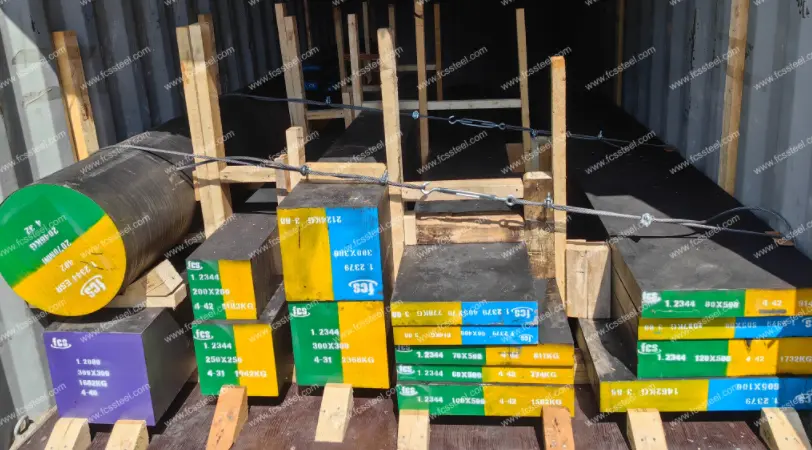
Nine key line items on your Request for Quotation (RFQ) decide whether your 1.2083 steel arrives tool-room ready or gets rejected for rework. Including these precise specifications directly on your Purchase Order (PO) prevents costly delays once machining begins:
Grade & Designation: Specify 1.2083 / X42Cr13 alongside the exact standard (e.g., EN 10088 or equivalent) and its revision year.
Supply Condition: Clearly state whether stock is annealed (~210–245 HB, requiring post-machining heat treatment) or pre-hardened/QT (target 48–52 HRC).
Delivery Form & Dimensions: Define whether you need forged round bars, plates, blocks, or pre-machined mold blanks.
Tolerances & Surface Finish: Set precise tolerances for flatness and straightness, specifying surface condition (peeled, ground, or milled) with required Ra values.
Material Certification: Require an EN 10204 3.1 Certificate detailing the heat number, chemical analysis, mechanical test results, and heat-treatment history.
Traceability: Demand physical heat-number stamping on each steel block/bar to maintain tracking throughout cutting and machining.
Non-Destructive Testing (NDT): Mandate ultrasonic inspection (UT) to guarantee internal soundness, especially for thick plates or high-polish medical/optical cavities.
Corrosion Environment: Avoid generic terms like "stainless." Define specific polymer types (e.g., PVC), cooling-water chemistry, and storage humidity.
Polishing & Acceptance Criteria: Specify the exact SPI/ISO polishing grade (e.g., SPI A-1) and request physical acceptance samples for mirror-finish cavities.
Conclusion
If your mold deals with steam, acidic plastics, or zero-tolerance optical finishes, 1.2083 tool steel prevents early failures. It handles the aggressive sterilization cycles and corrosive outgassing that leave standard P20 rusted out in weeks.
A single bad block of material can scrap a high-value tool. When you source 1.2083 from FCS Steel, you get ESR-refined steel that holds an SPI A-1 mirror polish without inclusions. Every piece ships with full EN 10204 3.1 material certifications, so your X42Cr13 chemistry and hardness specs are verified before the first cut.
Bring your target hardness, finish requirements, and specs to FCS Steel to keep your tool room on schedule.


